Tuesday, August 18, 2015

Oren’s Problem: Can We Handle the Truth?


Michael Oren’s recent articles and Ally, his autobiographical account of his tenure as Israel’s ambassador to the United States, have provoked quite a response. Some are upset by the opinions he has expressed about the Obama administration, and a number of critics have expressed surprise that Oren is saying and writing things he didn’t say while he was ambassador. 

Here’s a news flash: a diplomat is supposed to be diplomatic. That means not fully revealing one’s thoughts, private opinions and assessments of what is actually going on at the time one is serving as a diplomat.  It means making the best of a tough situation and putting a positive spin on stories and situations, even when they are not positive.

As I wrote in a Times of Israel column when Oren completed his term as Israel’s Ambassador to the United States, “His approach has been to engage and disarm with charm and facts those who oppose the positions of Prime Minister Netanyahu, leading me to wonder if those who so vehemently oppose Netanyahu, but so warmly embrace Oren realize how closely Oren is aligned with Bibi and how much he supports his positions and policies.” 

Many seem to be genuinely surprised and even personally offended to learn that Oren endorsed and believed in the policies of the Prime Minister he served and that he actually advocated the positions he espoused as ambassador.  His criticism of American Jews and Jewish figures does not sit well with some.  It seems as though many of those same American Jews who are quick to offer advice and critiques of Israel and Israeli policies believe it should be a one-way street. 

Rather than offer a simplistic assessment, Oren lays out the nuances and subtleties of the Obama administration’s approach to Israel during his years as Israel’s Ambassador to the United States.  I saw up close and first-hand how delicately he handled the crisis that erupted after the visit of Vice President Biden to Israel. As he mentions in his book, he came to speak at my synagogue right after having been summoned to the State Department.  As he sat down next to me on the bema, he whispered that he did not know what to say, having come directly from the State Department where he had just been summoned to be berated over the announcement by a municipal official of the expansion of a housing development in Jerusalem. Yet, despite the crisis and the interruption of his speech by several calls from the Prime Minister, he proceeded to speak calmly, not to lose his composure and to not publicly reveal the extent of the intensity of the condemnation and the rift. 

Perhaps one of the reasons for the rocky reception to his book and articles is that he shares painful truths about what transpired behind the scenes during tough times. He writes about ways in which Obama was helpful, but also reveals the animosity and sometimes petty slights Obama displayed towards Israel and its elected leader. The president strangely choosing not to mention Israel’s widely recognized Herculean efforts after the hurricane in Haiti while citing the help of other nations, the lack of any praise for the unprecedented and politically courageous decision to freeze settlements for ten months, while not demanding any reciprocal actions on the Palestinian side, and other actions by the president and his administration present uncomfortable truths for those who want to believe that President Obama has always acted as a supporter of Israel.  

Since Oren is a scholar, historian and writer of note, his book chronicling these years will be a valuable tool to those seeking to understand US policy during a tough and antagonistic period in US – Israel relations. 

Perhaps the problem, as expressed by Jack Nicholson’s character in the movie “A Few Good Men,” is that some people just can’t handle the truth. 

Tuesday, June 30, 2015

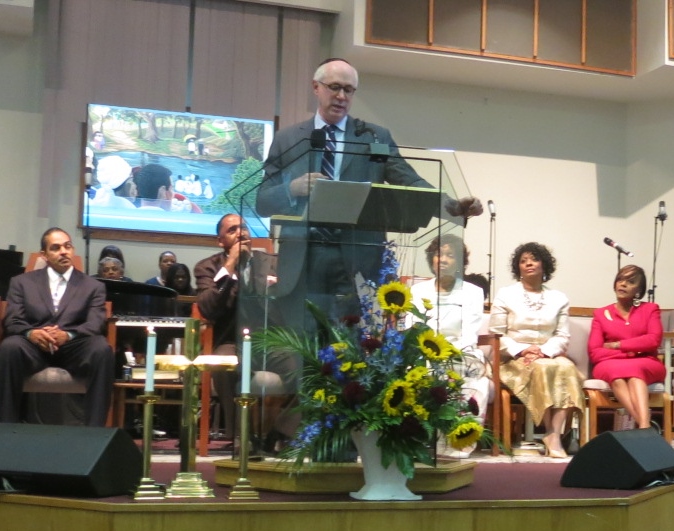
Rabbi Weinblatt's Speech at a Baptist Church on the Charleston 9


Rabbi Weinblatt organized a national effort endorsed by 18 major national Jewish organizations to show support for the African American community and to express abhorrence of the horrific act of violence in Charleston, SC. Below is the sermon he gave this past Sunday at the People’s Baptist Church in Silver Spring, MD.


Speech at People’s Baptist Community Church


I am here this morning as an American.

I am here as a Jew, and I am here as a rabbi. 

Rabbis around the country spoke in synagogues this Sabbath to express solidarity with the African American community.  In my synagogue we read the names of the nine killed in Charleston when we said the prayer at the end of our service honoring those who have passed, and we stood as one in their honor. And just as there are members of the Jewish faith who are attending black churches today to show support and solidarity in light of the tragedy in Charleston, I am here to bring a simple message:

You are not alone. 

We feel your loss. 

Your pain is our pain.

The Bible teaches us:  Thou shalt not stand idly by the blood of your neighbor. 

The Bible teaches:  That we are all God’s children, for we are all created b’tzelem Elohim, in the image of God, and that we are all equal in the eyes of the Lord.

The Bible teaches:  To never forget that we were once strangers in the land of Egypt. 

So that is why I stand here today, because of the powerful imperative of Jewish tradition to plead the cause of the orphan, the stranger and the widow and because we are commanded to love our neighbors.   

Unfortunately, there are too many things our people share in common.  Throughout history, Jews were killed because they were different, because they taught and practiced the word of God.  When I heard that people were gunned down in a church while studying words of God, just because they were black I was outraged, and knew that we had to do something.  And my sons who were with me on a trip encouraged me to organize this national response.

I couldn’t help but recall similar incidents that have happened to Jews.  Just this past November hate-filled terrorists entered a synagogue in Romema, Israel and brutally butchered people.  Just as in 2008 an Arab terrorist entered a Yeshivah, a holy place of study in Jerusalem, and filled with hatred for Jews methodically killed eight students who, just like the victims in Charleston, were studying words of God. 

Yes, our experiences are similar.  Our history is so much like your history.  Our stories are intertwined. 

And that is why Jews have always been in the forefront of the civil rights movement.  It is why Jews were so actively involved in desegregation and marched with Martin Luther King to shatter the shackles of injustice.  

I will never forget the time I was arrested for demonstrating for freedom for the Jews behind the Iron Curtain in Soviet Russia about 25 years ago.  After a long day in jail, just before we stood before the judge as we were about to be released, a black sheriff ushered us into the courtroom.  Quietly he said to us, “As an officer of the court I have to be officially neutral, but I want you to know I am on your side.  I will never forget all your people have done for my people. ”

And so that is why I am here today – because I want you to know – I, and the whole Jewish community are with you and on your side.

As a young boy, I learned early on that our fates are intertwined – which is why I cherish this famous photo of the 1963 March on Washington.  If you look closely at the picture, you will see that there is a man in a white shirt right behind Dr. King.  That man was Sam Weinblatt, my father.  So I learned at a young age that your cause is our cause.

One summer I worked as a teenager in a factory in Baltimore.  An elderly black gentleman, Mr. Gray, took me under his wings.  I would always take my breaks with him. I would listen to his words of wisdom as he smoked a cigarette and I drank a coke. 

One day, as we were sitting in the lunch room, a guy who was hired as a day worker started spewing hate and saying all kinds of terrible things about Jews.  I didn’t know what to say or do.  Mr. Gray gently but his hand on my arm, letting me know I should stay quiet.  Later when we went outside during our break he said to me, “You know if I wasn’t in the room, he would have been saying terrible things not just about Jews, but about black folks also.”

It is no coincidence that the man (I’m not even going to say his name) who shot people in Charleston wrote how much he hates Jews as well as blacks.

But what that man could not anticipate was that acts of hatred would be met with a response of love and forgiveness. What that man could not fathom was that his act of hatred would bring about an outpouring of mercy and compassion.  What he didn’t know is that love is stronger and more powerful than hate. 

So let us commit ourselves to work together in the name of the nine innocent people who were murdered in Charleston against racial injustice, against intolerance -- acts that we call Hillul HaShem, which desecrate the name of God.

The Bible commands us – Tzedek, tzedek tirdof:  Justice, justice shall you pursue.  Let us continue to walk the path together to pursue justice and to walk in the way of the Lord. 

We pray that this country shall live under the Providence of the Almighty God, and that it will be an influence for good throughout the world. United by the spirit of God and inspired by the teachings of Heaven we pray that citizens of all races and creeds shall forge a common bond to banish all hatred and bigotry.  May all who live on earth realize we have not come into being to hate or destroy, but to love.   May the powerful words of the prophet come to pass – that love and justice shall flow like a mighty stream.